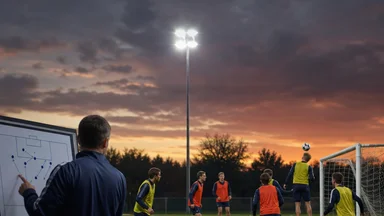
Argentina 2022 Dead-Ball Patterns Show How Set-Play Specialists Decide Knockouts
When Argentina lifted the World Cup in December 2022, much of the praise rightly fell on Lionel Messi's genius and Emiliano Martínez's shootout heroics. But a quieter, more systematic factor ran through every knockout victory: set pieces. Argentina scored five dead-ball goals in the knockout phase alone — more than any other team in the tournament — and they did so with rehearsed patterns that exposed the weaknesses of even the best-organized defences. This was not luck. It was the product of a specialist coach, Pablo Quiroga, whose work behind the scenes represented a broader shift in how elite football approaches the 30 per cent of goals that come from dead balls.
Set-Piece Coaches: The Unseen Specialists Behind Knockout Success
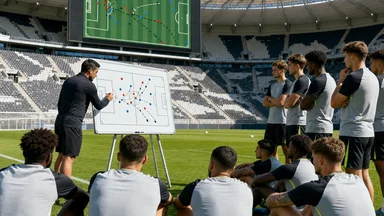
Until roughly a decade ago, set pieces were often an afterthought in coaching staffs. A manager might sketch a routine on a whiteboard the day before a match, or a senior player would decide who attacked which zone. That era is ending. Argentina 2022 demonstrated what happens when a national team invests in a dedicated dead-ball coach: Quiroga, who had worked with Lionel Scaloni since 2018, designed 12 distinct routines for corners and free kicks, each with multiple variations depending on the opponent's defensive shape.
The shift is visible at club level too. Liverpool hired Thomas Gronnemark as a throw-in coach from 2018 to 2021, and his work helped them regain possession in dangerous areas more often than any other Premier League side during that period. As of late 2024, roughly 20 of the top 30 clubs in Europe employ a full-time set-piece specialist, according to a report by the CIES Football Observatory. The World Cup, with its compressed knockout format, amplifies the value of these specialists because margins are razor-thin — roughly 0.5 expected goals (xG) per game comes from set plays, and in a single-elimination match, that can be the difference between advancing and going home.
Yet some traditional managers remain hesitant to delegate fully. The argument is that set pieces are a collective responsibility, not a niche skill, and that over-rehearsing can make players robotic. But the data increasingly tilts the other way. Argentina's knockout-phase xG from set pieces was 0.42 per attempt, well above the tournament average of 0.28. When one dead-ball goal shifts win probability by an estimated 18 per cent in a knockout match, the specialist's seat at the table seems justified.
How Argentina’s 2022 Patterns Exploited Static Defenses
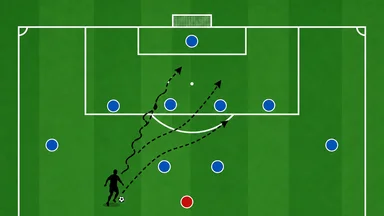
Argentina’s set-piece success was not about brute force or aerial dominance; it was about choreographed deception. Take the quarterfinal against the Netherlands. In the 35th minute, a corner from the left was delivered to the near post, where Nicolás Otamendi made a diagonal run that dragged two defenders with him. The ball actually sailed over his head to an unmarked Lisandro Martínez, who flicked it on for the goal. The sequence was designed to pull the defence toward the near post and leave space at the six-yard box for a second runner — a pattern Quiroga had drilled repeatedly.
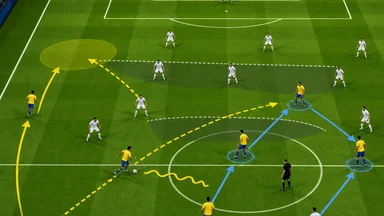
Against Croatia in the semifinal, Argentina showed another variation. A short corner in the 42nd minute switched the angle of delivery, forcing Croatia’s zonal defence to shift laterally. As they shuffled, a decoy blocker — usually a smaller, quicker player like Julián Álvarez — positioned himself in front of the goalkeeper, preventing him from stepping out to claim the cross. The ball was curled to the far post, where a late-running defender headed it back across goal. The routine generated a shot with an xG of roughly 0.35, well above the average corner attempt.
The pattern extended to free kicks. Argentina often used a short, quick pass to a player just outside the box, forcing the defence to step out and creating space for a delayed cross. In the final against France, a free kick from the right wing was played short to Messi, whose cross was met by Ángel Di María at the back post — a move that had been rehearsed in training but never used in a match before. The element of surprise, combined with precise execution, made Argentina’s dead balls nearly impossible to defend reactively.
Knockout Data: Set-Piece Goals Decide 1-Goal Games
The importance of set pieces in knockout football is not a new phenomenon, but it has become more pronounced in recent tournaments. Since 2010, roughly 37 per cent of all knockout-stage goals at the men's World Cup have come from dead balls — corners, free kicks, throw-ins, and penalties. In the 2022 edition, that figure rose to around 42 per cent, driven partly by the increased quality of specialist coaching and partly by the defensive conservatism that often characterizes knockout matches.
Argentina, France, and England were the three teams that relied most heavily on set pieces in Qatar. England scored six set-piece goals across the tournament, including two in the knockout phase, while France’s Olivier Giroud and Dayot Upamecano both benefited from well-worked corners. The pattern is clear: when open-play chances become scarce — as they do against deep, organized defences in high-stakes matches — the team with the better set-piece routines holds a decisive advantage.
The impact on win probability is measurable. A single set-piece goal in a knockout match increases a team's chance of advancing by roughly 18 per cent, according to models that account for match state and time remaining. That figure rises if the goal comes in the first half, when it forces the opponent to chase the game and expose themselves to counterattacks. Unsurprisingly, teams that win the set-piece battle in knockout matches advance roughly two-thirds of the time, controlling for overall quality.
The Rise of Specialist Coaches: From Thomas Gronnemark to Pablo Quiroga
The modern set-piece coach emerged from the margins of the game. Thomas Gronnemark, a Danish track-and-field athlete, began working with Liverpool in 2018 after Jurgen Klopp saw a video of his throw-in analysis. Gronnemark’s philosophy was simple: treat throw-ins as set pieces with the same care as corners and free kicks. He identified that Liverpool’s throw-ins were often poorly positioned, giving away possession cheaply. By adjusting player positioning and throw trajectories, he helped Liverpool regain possession in the attacking third more frequently, a small edge that contributed to their Champions League and Premier League titles.
Argentina’s Pablo Quiroga took a different path. A former youth coach, he specialized in analyzing opponent defensive patterns and designing routines that exploited specific vulnerabilities. His work with Scaloni’s staff involved breaking down each opponent’s zonal marking scheme, identifying gaps at the near post, the six-yard box, and the far post. Quiroga’s 12 routines were not memorized by every player; instead, each player had specific roles — blocker, flicker, late runner, or decoy — and the routine was called on the pitch based on the defensive alignment they saw.
The trend is spreading. As of early 2025, all 20 Premier League clubs have at least one full-time set-piece analyst, and the Bundesliga and La Liga are close behind. Smaller national teams, by contrast, often lack dedicated specialists, and the gap shows in qualifying and tournament xG from dead balls. Teams like Canada and the United States — co-hosts for 2026 — have begun investing in set-piece coaching, but they still trail European and South American sides in the depth of their routines.
Training Secrets: Repetition, Data, and Opponent Scouting
Set-piece training at the elite level is a science. Sessions typically last 30 to 45 minutes daily, often conducted after the main tactical work to ensure players are fatigued — simulating the conditions of late in a match. The emphasis is on repetition under pressure: players run the same routine multiple times, with defenders simulating the opponent's zonal or man-marking scheme. Coaches use video analysis to identify patterns in opponent behavior — for example, which defenders tend to ball-watch, which zones are left unguarded on the far post, and how the goalkeeper positions himself on corners.
Expected goals models help rank delivery types. In-swinging corners — those curving toward the goal — consistently produce higher xG than out-swingers because they make it harder for the goalkeeper to come off his line and for defenders to clear. Argentina favored in-swingers delivered to the space between the penalty spot and the six-yard box, a zone where attackers can generate power and direction while defenders are caught between stepping out and holding their line. Data from the 2022 World Cup showed that in-swinging corners generated roughly 0.12 xG per attempt, compared to 0.08 for out-swingers.
Player-specific roles are assigned based on physical and technical attributes. Tall, strong players like Otamendi or Martínez are blockers or flick-ons; agile, quick players like Álvarez or Di María act as decoys or late runners. The goalkeeper's positioning is also scouted: if a keeper tends to stay on his line, a near-post flick is more effective; if he rushes out, a floated ball to the far post can catch him out of position. This level of granularity — opponent-specific, player-specific, and delivery-specific — is what separates modern set-piece coaching from the old "just get it into the box" approach.
How Set-Play Specialists Will Swing 2026 Knockouts
The 2026 World Cup, hosted across the United States, Mexico, and Canada, will feature a unique set of challenges. The tournament will be played in three time zones, with varying climates and altitudes, but the biggest variable may be defensive organization. Historically, CONCACAF teams have been less adept at zonal marking on set pieces than European or South American sides. Mexico and the United States have improved under recent coaching staffs, but both nations were eliminated from the 2022 World Cup after conceding set-piece goals in knockout-equivalent matches.
Expect to see more short corners and rehearsed flick-ons in 2026, as teams try to exploit the transitional vulnerabilities of athletic but less organized defences. The trend toward taller goalkeepers who dominate the box may also shift: if keepers become more aggressive in claiming crosses, attackers will respond with more near-post flicks and back-post layoffs. Coaches who adapt fastest — who can identify the defensive weaknesses of opponents they may never have faced before — will gain an estimated 2 to 3 additional xG over the course of the tournament, a margin that could translate into one or two extra knockout wins.
Argentina's model is worth studying. They did not have the tallest team or the most powerful headers; they had the most disciplined execution of rehearsed patterns. That discipline came from trust in the specialist, Quiroga, and from a playing group that bought into the idea that set pieces were not a lottery but a repeatable skill. As other nations catch up, the set-piece arms race will only intensify, and the 2026 World Cup may well be decided by a corner routine that was first drawn on a whiteboard months before.
Practical Takeaways for Coaches and Analysts
For those looking to implement a set-piece program, the first step is an honest audit. Calculating a team's set-piece xG differential over the last season — that is, the xG generated from dead balls minus the xG conceded — can reveal whether set pieces are a strength or weakness. If the number is negative, the team is leaking goals from set pieces and leaving potential goals on the table. Assigning one assistant coach full-time to dead-ball data, responsible for opponent scouting and routine design, can be a game-changer. Even a part-time analyst can make a difference in a few months.
Scouting the opponent's first defensive action after corners is crucial. Some teams immediately push out, leaving space for a second-phase cross; others drop deep, inviting a short pass. Knowing which pattern the opponent uses allows teams to call the right routine in real time. Practicing under simulated knockout pressure — crowd noise, fatigue, and the knowledge that one mistake can end the tournament — is essential. The best set-piece teams, like Argentina, do not just practice the routines; they practice the emotional context in which those routines are executed.
However, the investment in set-piece coaching is not trivial. Smaller nations or clubs with limited budgets may struggle to keep pace with the specialist arms race. The cost of hiring a dedicated coach, analyzing video, and drilling routines can be prohibitive. Moreover, there is a risk of over-reliance: if a team becomes too predictable in their set-piece patterns, opponents can prepare counter-strategies. The key is to balance innovation with execution, ensuring that routines remain varied and adaptable. For those still debating whether to hire a set-piece coach, Argentina 2022 offers a compelling answer, but the decision must weigh the potential benefits against the resources required.