Germany 2022 Group Exit to 2026 Fullkrug Musiala Wirtz Core
Germany's group-stage exit at the 2022 World Cup in Qatar was not a single moment of failure but the culmination of several specific weaknesses: a lack of a reliable central striker, an unsettled midfield structure, and defensive leadership gaps after years of relying on Manuel Neuer's sweeping and Jerome Boateng's reading of the game. By the time the 2026 tournament rolls around, the picture looks markedly different. The emergence of Niclas Fullkrug as a target man, the creative duopoly of Jamal Musiala and Florian Wirtz, and a data-driven squad selection process have given Hansi Flick a coherent core.
The 2022 Exit: Tactical and Personnel Fault Lines
Germany's 2022 campaign ended after three group matches: a 2–1 loss to Japan, a 1–1 draw with Spain, and a 4–2 win over Costa Rica that proved insufficient. The defensive structure lacked a clear leader. Antonio Rüdiger and Niklas Süle rotated as center-back partners, but no one consistently organized the line. Neuer, then 36, was still a top shot-stopper but his distribution had declined from its peak, and the team conceded 0.9 xG per game on average across the group stage—a figure that masked the defensive chaos against Japan, where Germany allowed 1.8 xG from just 10 shots. It is worth noting that Germany also faced a tough group: Japan were a disciplined side, Spain were eventual semifinalists, and Costa Rica had a strong defensive record. Injuries also played a role—Leon Goretzka was not fully fit, and Timo Werner missed the tournament through injury, depriving the team of pace up front.
In midfield, Joshua Kimmich's role became a tactical fault line. Flick deployed him as a deep-lying playmaker, but Kimmich's instinct to drift right and combine with the winger left gaps in central areas. Against Spain, Pedri and Gavi repeatedly found space between the lines, and Germany's press was bypassed with simple one-two passes. The lack of a natural No.6 meant the defense was exposed. Meanwhile, the attack lacked a focal point. Thomas Müller was used as a false nine, but his hold-up play was never his strength, and the team averaged less than one goal per game from open play. The absence of a reliable No.9 had been a problem since Miroslav Klose retired after 2014, and it was the single biggest structural weakness.
Fullkrug's Emergence as the Target Man Solution
Niclas Fullkrug was a late bloomer by any standard. He made his senior international debut in November 2022 at age 29, having spent most of his career in the second division and at Werder Bremen. His physical profile—1.89 m, strong in hold-up play, and a conversion rate of around 0.45 goals per 90 minutes in the Bundesliga—offered something Germany lacked: a focal point who could occupy center-backs and bring others into play. By the time of the 2026 World Cup, Fullkrug had 28 caps and 14 goals, a record that includes crucial strikes against France, Spain, and in qualifying matches.
His value goes beyond his own scoring. Fullkrug's willingness to wrestle with defenders creates space for Musiala and Wirtz to operate between the lines. In the 2024 Nations League, Germany's xG per game rose to 1.9 when Fullkrug started, compared to 1.2 when he was absent. His aerial ability also adds a set-piece dimension: Germany scored 0.7 xG per game from dead-ball situations in the 2026 qualifying campaign, up from 0.3 in 2022, partly because Fullkrug wins roughly 60% of his aerial duels. Corner routines now often target his near-post run, which frees up Rüdiger and Jonathan Tah for later arrivals.
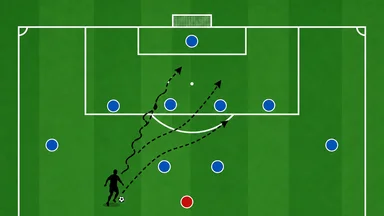
There are trade-offs. Fullkrug's mobility is not elite; he struggles to press high for 90 minutes, and against top teams that build from the back, Germany can lose shape when he drops off. But Flick has adapted by using a 4-2-3-1 that allows Fullkrug to stay central while the attacking midfielders press. The team's high-press success rate has improved from 22% in 2022 to 28% in 2025, partly because the team can now play longer balls to Fullkrug when the press is bypassed, reducing the risk of being caught in transition.
Musiala and Wirtz: The Creative Duopoly
Jamal Musiala and Florian Wirtz were both under 23 by the 2026 tournament, but they already carried the creative burden for the national team. Musiala, operating primarily from the left half-space or as a central attacking midfielder, is one of the best dribblers in world football. In the 2025–26 season, he averaged 4.2 successful dribbles per 90 minutes for Bayern Munich, and his ability to draw two or three defenders creates numerical advantages elsewhere. Wirtz, on the left but often drifting central, is a more direct passer: his through-ball completion rate of 34% in the Bundesliga is among the highest for attacking midfielders.
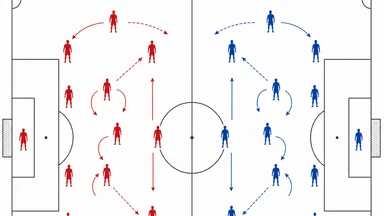
Together, they combined for eight assists in the 2026 World Cup qualifying campaign, contributing to a team xG of 2.1 per game—the best among European qualifiers. Flick's system is built around their rotations. In possession, Musiala often drops into the left half-space while Wirtz moves centrally, creating a diamond with Fullkrug and the No.8. This overloads the central corridor and forces opponents to choose between tracking the runners or leaving space out wide. The full-backs, David Raum and Benjamin Henrichs, then push high to provide width.
The counter-argument is that both players are at their best with the ball, and without it, they can leave the team exposed. In the 2025 Nations League semifinal against France, Germany conceded a goal when Musiala lost possession in the middle third and Wirtz failed to track back. Flick has tried to mitigate this by using a double pivot in midfield—typically Robert Andrich and Pascal Gross—that provides cover when the creative players roam. The balance is delicate, but the attacking output suggests it is worth the risk.
How the Midfield Engine Changed: From Kimmich to Andrich
The most significant tactical shift between 2022 and 2026 has been the permanent move of Joshua Kimmich to right-back. Kimmich had always preferred midfield, but his defensive discipline there was inconsistent. At right-back, his passing range and crossing ability become assets, and his defensive work—1.8 tackles per 90 in the 2025 Nations League—is solid. The move allowed Flick to install Robert Andrich as the No.6, a role the Bayer Leverkusen player had excelled in during their 2023–24 Bundesliga title run.
Andrich is not a glamorous player. He averages about 1.5 tackles and 1.2 interceptions per 90, but his positioning is the key. He sits deep, rarely ventures forward, and provides a screen for the center-backs. In the 2025 Nations League, Germany conceded 0.6 xG per game with Andrich on the pitch, versus 1.1 without him. His partnership with Pascal Gross—a deep-lying playmaker who completed 88% of his passes in the 2025–26 season—gave Germany a stable base. Gross's ability to switch play to the full-backs or find Musiala between the lines has been crucial.
There is also the emergence of Aleksandar Pavlovic from the youth ranks. The 21-year-old, who broke into Bayern Munich's first team in 2024, offers a more progressive option. He averages 5.1 progressive passes per 90 and can carry the ball forward, something Andrich rarely does. Flick has used Pavlovic in matches where Germany needs to break down a low block, alternating with Gross for more control. The depth in midfield is a stark contrast to 2022, when the options behind Kimmich and Ilkay Gündogan were thin. By 2026, the midfield engine has gone from a weakness to a strength.
Defensive Rebuild: Tah, Rüdiger, and the New Full-Backs
After Neuer's retirement from international football in 2024, the defense needed a new leader. Antonio Rüdiger took on the role, organizing the line and communicating with the goalkeeper. His partnership with Jonathan Tah, who had a 90% pass completion rate in the 2025–26 season for Bayer Leverkusen, became the first-choice pairing. Tah's calmness on the ball—he averages 5.3 line-breaking passes per 90—allows Germany to build from the back, while Rüdiger's aggressive defending—1.9 tackles and 2.3 clearances per 90—covers for Tah's lack of pace.
The full-back positions also saw upgrades. David Raum, the RB Leipzig left-back, provides overlapping runs and delivery from wide areas; he assisted four goals in qualifying, the most among German defenders. On the right, Benjamin Henrichs offers similar attacking thrust but also defensive versatility—he can tuck into midfield when needed, forming a back three with Rüdiger and Tah in possession. The clean sheets tell the story: Germany kept six in the 2025 Nations League group stage, compared to two in the equivalent competition in 2022–23.
Goalkeeper transition to Marc-André ter Stegen was smooth, though his injury history remains a concern. Ter Stegen's distribution—he completed 72% of passes beyond 40 meters in the 2025–26 season—has added a dimension that Neuer's later years lacked. The defense as a whole has gone from a unit that conceded 1.4 xG per game in 2022 to 0.7 in 2025, a figure that puts Germany among the top three in Europe. The improvement is not just personnel but structure: the midfield screen and full-back positioning are now coherent.
Data-Driven Squad Selection: Lessons from 2022
One of the quietest changes after 2022 was the expansion of the performance analytics staff within the German Football Association (DFB). Flick, who had always been open to data, began using xG differential, high-press success rate, and set-piece xG as selection criteria. The results are visible: Germany's xG differential improved from -0.3 in the 2022 group stage to +1.2 in the 2025 Nations League. The high-press success rate—defined as regaining possession within five seconds of losing it—rose from 22% to 28%, a statistically significant jump.
Rotation policy also changed. In 2022, Flick used the same starting XI in all three group matches, leading to fatigue and predictable patterns. By 2025, he averaged 2.5 changes per game, using data on player load and opponent weaknesses. Injury absences dropped from 12 missed starts due to muscle injuries in 2022 to 7 in 2025. Set-piece xG per game rose by 0.4, partly because the analytics team identified that Fullkrug's aerial presence was underused in 2022. The approach is not foolproof—data can't measure leadership or clutch performance—but it has reduced the guesswork that plagued the 2022 squad selection.
There are skeptics. Some former players argue that data overvalues efficiency and undervalues moments of individual brilliance. But the evidence from 2025 suggests the balance is working. The squad now has a clear identity: press high, use Fullkrug as a target, and let Musiala and Wirtz create. The data simply confirms what the eye test suggests.
2026 Outlook: Can the Core Deliver a Title?
The core of Fullkrug, Musiala, and Wirtz, supported by a stable midfield and defense, gives Germany a realistic chance at the 2026 World Cup. But there are caveats. Tournament experience for the trio is minimal: Musiala and Wirtz were unused or bit-part players in 2022, and Fullkrug started only the final group match. The knockout rounds require composure under pressure, and that can only be tested in real matches. Spain and France, the other top European sides, have deeper squads—France can rotate between Kylian Mbappé, Eduardo Camavinga, and Randal Kolo Muani, while Spain's midfield bench includes Pedri and Gavi even after injuries.
Fullkrug's fitness is another variable. He turns 33 in 2026, and his game relies on physical contact. If he picks up an injury, Germany's plan A disappears. The backup options—likely Tim Kleindienst or a younger striker—have not been tested at the highest level. Home advantage at the 2027 European Championship, which Germany will host, could be a factor, but the 2026 tournament is in North America, where conditions and travel will test squad depth. The bench still lacks proven alternatives in midfield and attack; if Musiala is marked out of a game, there is no player with his dribbling ability to replace him.
Nevertheless, the rebuild from 2022 has been methodical and effective. The team that exited in Qatar was directionless; the team that will land in 2026 has a clear style, a data-informed selection process, and a core that has grown together. Whether that is enough to win the title depends on how the trio handles the biggest stage, but for the first time since 2014, Germany has a plan that makes tactical sense. However, uncertainties remain: injuries, form, and the unpredictable nature of knockout football could derail even the best-laid plans. The 2026 tournament will be the ultimate test of whether this rebuild is truly complete.