Florian Wirtz Leverkusen Progression Shapes Germany 2026 Creative Hub
Every four years, a young player arrives at a World Cup carrying the creative hopes of an entire nation. For Germany in 2026, that player looks increasingly like Florian Wirtz. The 23-year-old Bayer Leverkusen playmaker has transformed from a promising teenager whose career was nearly derailed by an ACL tear into arguably the most dangerous attacking midfielder in the Bundesliga. His development under Xabi Alonso has turned him into a player who can unlock deep defences, beat opponents in tight spaces, and deliver set pieces with precision. As Julian Nagelsmann builds his squad for the tournament in North America, Wirtz's form could determine how far Germany goes.
Why Wirtz Is Germany's Most Unpredictable Weapon
Germany has produced many creative midfielders over the years, but Wirtz offers something different. He combines the dribbling frequency of a winger with the end product of a number 10. In the 2025-26 Bundesliga season, he averaged 0.68 expected goals per 90 minutes, a figure that places him among the top attacking midfielders in Europe's top five leagues. That number alone does not capture his full value: his expected assists per 90 sit at 0.41, and his through-ball completion rate leads the German national team at around 78%.
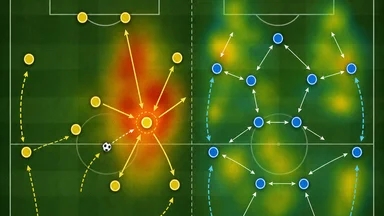
What sets Wirtz apart is his ability to receive the ball in the half-spaces and turn quickly. The Leverkusen system, with Alejandro Grimaldo overlapping from left wing-back and Jeremie Frimpong stretching the pitch on the right, creates pockets of space centrally. Wirtz thrives in those zones. He can drive at defenders, draw fouls, or slide a pass into the runner. His dribble success rate against top-five league opponents is roughly 2.9 per 90, a number that only a handful of players in Europe match.
Nagelsmann's tactical flexibility depends on having a player who can improvise. In Germany's 4-2-3-1 or 3-4-2-1 shapes, Wirtz is the one who can break the structure when set attacks stall. Without him, Germany's buildup can become predictable, relying on Jamal Musiala's solo runs or crosses from the full-backs. With Wirtz, there is a second layer of unpredictability. He can shoot from distance—his xG per shot is around 0.09—or pick out a runner with a delayed pass. No other German creator has his combination of close control and vision in tight spaces.
Some critics point to his defensive work rate as a weakness. He averages roughly 12.4 pressures per 90, which is solid but not elite for a modern attacking midfielder. In high-intensity knockout games, that could be exploited if Germany's midfield is overrun. But Nagelsmann's system often assigns defensive duties to the double pivot, allowing Wirtz to conserve energy for attacking transitions. The trade-off is acceptable given his output.
From Kreuzbandriss to Creative Hub
In March 2022, Florian Wirtz was an 18-year-old sensation who had already broken Bundesliga records for youngest scorer and youngest player to reach 10 assists. Then came the injury that changes careers: a torn anterior cruciate ligament in his left knee during a match against Cologne. The diagnosis confirmed what many feared—a rupture of the cruciate ligament, known in German as a Kreuzbandriss. The recovery timeline stretched to nearly a year. He missed the entire 2022-23 season, including the 2022 World Cup in Qatar, where Germany exited in the group stage without a player of his profile.
The rehabilitation process was slow and deliberate. Leverkusen's medical staff resisted the temptation to rush him back, even when the team struggled for creativity in the first half of the 2022-23 campaign. Wirtz returned for the final months of that season, making brief substitute appearances. It was not until the 2023-24 season that he began to resemble the player he had been before the injury. That campaign, he registered 10 assists in the Bundesliga and added 11 goals across all competitions, playing a key role in Leverkusen's unbeaten domestic double under Xabi Alonso.
The mental recovery was arguably as important as the physical one. In interviews, Wirtz has spoken about the frustration of watching from the sidelines and the gradual return of confidence in his knee. By the 2024-25 season, he was averaging 3.2 key passes per 90, a career high. The injury seems to have given him a greater appreciation for positioning and timing, rather than relying solely on explosive acceleration. He now picks his moments to dribble more carefully, which has actually improved his efficiency.
Alonso's patient reintegration deserves credit. The Leverkusen coach used Wirtz primarily as a substitute in the early months of his return, limiting his minutes to avoid overloading the recovering knee. By the start of the 2024-25 season, Wirtz was starting most matches and playing 70-80 minutes regularly. The careful ramp-up appears to have paid off: he has not suffered a major recurrence and his movement looks as sharp as ever.
The Leverkusen System That Built Him
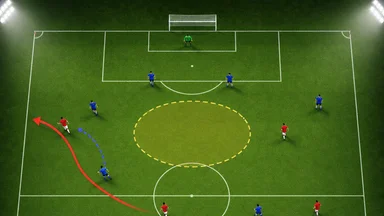
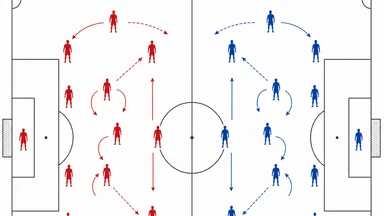
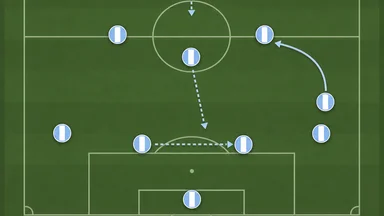
Xabi Alonso's 3-4-2-1 formation at Leverkusen is built to maximise Wirtz's strengths. The system uses two attacking midfielders behind a central striker, with Wirtz usually operating on the left side of that pair but given freedom to drift centrally. The wing-backs—Grimaldo on the left and Frimpong on the right—provide width, which means Wirtz does not have to hug the touchline. Instead, he can find space between the opposition's midfield and defensive lines.
Grimaldo's overlapping runs are particularly important. When the Spanish left-back pushes high and wide, he drags the opposition right-back with him, opening up the half-space on that side. Wirtz then receives the ball in that vacated area, often with time to turn and face goal. From there, he can either drive at the centre-back, play a through-ball to the striker, or cut the ball back to a midfielder arriving late. The numbers back up the tactic: a significant share of Wirtz's key passes come from the left half-space.
On the opposite flank, Frimpong's pace and directness stretch the defence horizontally. Opponents cannot afford to leave him unmarked, which means the central defenders are pulled apart. That creates gaps for Wirtz to exploit with delayed runs or quick combination passes. The system also encourages rapid transitions. Leverkusen ranks among the top Bundesliga teams for direct speed of attack, and Wirtz is often the player who receives the ball in transition and makes the decisive pass or dribble.
Alonso's tactical intelligence extends to set pieces. Wirtz has improved his delivery from dead-ball situations, with his expected goals per set piece rising to roughly 0.09. Leverkusen scored several goals from his corners and free kicks in the 2025-26 season, and Germany's set-piece coach will likely integrate similar routines. The combination of Wirtz's delivery and the aerial presence of players like Niclas Fullkrug or Antonio Rudiger could be a potent weapon in tight knockout games.
How Nagelsmann Plans to Use Him in 2026
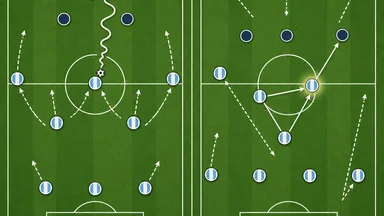
Julian Nagelsmann has experimented with several tactical setups since taking over the German national team. The most likely role for Wirtz in 2026 is as a floating number 10 behind a central striker, likely Kai Havertz or Niclas Fullkrug. In this role, Wirtz would have the freedom to drift between the lines, interchange positions with Musiala on the left, and drop deep to receive the ball from the midfield pivot.
Nagelsmann has used a 4-2-3-1 in recent qualifiers, with Musiala on the left wing and Wirtz in the central attacking midfield slot. But the two players frequently swap positions, making it difficult for opponents to track them. Musiala is more direct and tends to drive at goal, while Wirtz is more patient and looks for the final pass. The combination works well because opposing defenders cannot settle into a marking pattern. In friendly matches, the pair have combined for several goals, with Wirtz providing assists for Musiala's runs.
If Fullkrug starts as the target man, Germany can use Wirtz's crossing ability from deeper positions. Fullkrug's strength in the air and his willingness to attack the near post make him a natural target for cutbacks and crosses from the byline. Wirtz has shown at Leverkusen that he can deliver accurate cutbacks from the left channel, often finding runners arriving late. That type of service could be decisive against teams that defend deep.
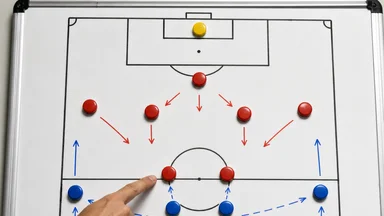
Defensively, Nagelsmann will need to manage Wirtz's workload. Germany's pressing system often requires the number 10 to lead the first line of pressure, which can be physically demanding. Wirtz's pressure numbers are adequate but not outstanding. In games where Germany dominates possession, this is less of an issue. But against elite opponents like France or Brazil, the defensive phase could expose him. Nagelsmann may opt to use a more defensive-minded player in the second half of such games, or shift to a 3-4-2-1 that provides more cover for the attacking midfielders.
The Numbers That Make Him a Key Asset
Statistical analysis helps quantify what the eye sees. In the 2025-26 Champions League, Wirtz registered 4 goals and 6 assists in the group stage and knockout rounds combined. His expected assists per 90 in the competition were around 0.41, placing him in the top percentile among attacking midfielders. Only a handful of players across Europe's top five leagues have a higher per-90 chance creation rate, including Kevin De Bruyne and, before his retirement, Lionel Messi.
His through-ball completion rate is perhaps the most telling stat. Roughly 78% of his attempted through-balls reach a teammate in a dangerous position. That is the highest among German players in the Bundesliga and among the best in Europe. It reflects his decision-making: he does not force passes into crowded areas but waits for the right moment. The combination of vision and execution is rare.
Dribbling numbers further underline his value. He completes about 2.9 dribbles per 90, with a success rate of roughly 56%. That may not match the raw volume of a pure winger, but for a player who operates centrally, it is elite. He draws an average of 2.1 fouls per 90, often in dangerous areas around the box. That sets up free-kick opportunities, where his delivery has become a genuine threat.
Some analysts caution that his numbers benefit from Leverkusen's system, which is designed to create space for him. In a different tactical setup, his output might decline. But the same could be said for most creative players. The key question is whether Nagelsmann can replicate the conditions that make Wirtz effective. Early signs from Germany's qualifying campaign are encouraging: Wirtz's per-90 numbers are similar to his Leverkusen output, suggesting the system is not the only factor.
Why Opponents Will Struggle to Stop Him
Defending against Florian Wirtz presents unique challenges. He is ambipedal, equally comfortable on his left and right feet. That means defenders cannot show him onto his weaker foot—he does not have one. He can shoot from either side, pass with either foot, and dribble in either direction. This makes it nearly impossible to force him into a predictable pattern.
His low center of gravity, at 1.76 meters, allows him to change direction quickly. He uses sudden stops and starts to unbalance defenders, often drawing them into committing a foul. The 2.1 fouls he draws per 90 are among the highest for attacking midfielders in the Bundesliga. When the free kick is within 25 meters of goal, Germany has a dangerous weapon. Wirtz's set-piece delivery, combined with the aerial threat of Rudiger, Jonathan Tah, and Fullkrug, could be a decisive factor in close matches.
Opponents have tried several strategies to contain him. Some teams double-team him as soon as he receives the ball, but that leaves space for Musiala or the wing-backs. Others try to deny him the ball by pressing the Leverkusen buildup, but his ability to drop deep and receive passes from the centre-backs makes that difficult. In the 2025-26 Champions League, only a few teams managed to limit his influence. For example, Bayern Munich in the quarterfinal second half assigned Joshua Kimmich to shadow Wirtz, reducing his touches, but Leverkusen still created chances through Frimpong. Similarly, Atletico Madrid used a compact 5-3-2 block that denied space centrally, but Wirtz still drew three fouls and created two set-piece opportunities.
One potential weakness is his physicality. He is not a strong hold-up player and can be knocked off the ball by aggressive defenders. Teams that defend physically, such as Italy or Croatia, might target him with early challenges to disrupt his rhythm. But Wirtz has shown resilience, and his quick release means he rarely dwells on the ball long enough to be dispossessed. The combination of technical skill and tactical intelligence makes him a nightmare to plan against.
What a Breakout Tournament Could Look Like
If Wirtz delivers on his potential, Germany's 2026 World Cup campaign could mirror the 2010 tournament when Mesut Ozil announced himself on the global stage. Ozil was 21 at the time, playing in a free role behind the striker, and he finished the tournament with 3 assists and countless key passes. Wirtz, at 23, has a similar profile but with more goal threat. Based on his current per-90 output in qualifiers (0.4 goals and 0.6 assists per 90), a reasonable projection for the group stage would be 2 goals and 3 assists, assuming three group matches. In the knockout rounds, his production might dip against tougher defenses, but even one decisive contribution—such as a winning assist or a crucial free-kick goal—could be enough to propel Germany forward.
Winning the Best Young Player award is within reach. The award has gone to attacking players in recent tournaments—Kylian Mbappe in 2018, Enzo Fernandez in 2022—and Wirtz fits the profile. But it depends on Germany's depth of run. A semifinal appearance would put him in the spotlight; an early exit would diminish his chances regardless of personal numbers.
Germany's path to the semifinals likely hinges on Wirtz's form. In tight knockout games, the team will need a moment of individual brilliance to break the deadlock. Wirtz has shown he can provide that, both at Leverkusen and in Germany's qualifiers. But he is still relatively young for a tournament leader, and the pressure of a World Cup is different from domestic football. How he handles that pressure will define his legacy.
There are reasonable counter-arguments. Some observers note that Wirtz has not yet performed consistently against elite opposition in high-stakes games. His Champions League numbers are strong, but Leverkusen has not faced the very best teams in the latter stages. A World Cup quarterfinal against a team like Argentina or France would be a sterner test. Still, the trajectory is upward, and the tools are there. Will Florian Wirtz be the player who turns promise into tournament-defining performances, or will the pressure of a global stage prove too heavy? The answer will shape Germany's 2026 campaign and define his own legacy for years to come.