Brazil 2014 vs 2026 Build-Up Play Loses Depth Without a True Playmaker
The evolution of Brazil's build-up play between the 2014 and 2026 World Cups offers a revealing case study in how the absence of a true playmaker can dilute attacking depth. In 2014, Neymar functioned as the creative hub, orchestrating from the left half-space and generating roughly 0.4 expected assists per 90 minutes. By 2026, the team has shifted toward a more fluid but less coherent distribution of creative responsibilities, leaving Brazil vulnerable against compact defenses that can crowd the final third. This analysis examines the tactical and metric differences between the two editions, the reasons behind the shift, and the adjustments Brazil might consider before the knockout rounds.
Why Brazil 2014 Thrived on a True Playmaker
The 2014 Brazil side, despite its semifinal collapse against Germany, built attacks through a clearly defined creative hierarchy. Neymar, nominally a left winger, drifted into central half-spaces to receive between the lines. His xA per 90 of 0.4 placed him among the tournament's elite chance creators. Oscar, operating as a No. 10, frequently dropped into deeper areas to link midfield and attack, while the wingers—Hulk on the right and Neymar on the left—inverted to overload the central zones. This structure generated an average of 0.27 xG per shot in the group stage, indicating high-quality chances.
The parallel to Spain's 2010 World Cup-winning side is instructive. Xavi and Iniesta formed a dual playmaking axis that controlled tempo and penetration. Brazil 2014 did not replicate that level of precision, but Neymar's role as a fixed creative reference point gave the team a consistent source of line-breaking passes. When Neymar was marked out of the game—as happened against Colombia in the quarterfinal, before his injury—Brazil struggled to create, a precursor to the semifinal collapse.
The 2014 team also benefited from full-backs Dani Alves and Marcelo, who provided width and underlaps, but the playmaking core remained central. Neymar's 18% share of final-third touches was the highest on the squad, concentrating creative output in one player. This made Brazil predictable but also highly effective against teams that could not double-team him without leaving space elsewhere.
2026 Build-Up: Fluidity Without a Fixed Creator
Fast-forward to the 2026 World Cup, and Brazil's approach has shifted toward distributed creativity. Vinícius Júnior, the team's most dangerous attacker, produces high dribble volumes but a relatively low assist rate—roughly 0.15 xA per 90 in recent tournaments. Rodrygo, often deployed as a false nine, lacks the final ball of a traditional playmaker. Lucas Paquetá offers moments of invention but has been inconsistent, averaging around 1.2 key passes per 90. No player in the current squad exceeds 1.5 key passes per 90, whereas Neymar in 2014 averaged nearly 2.5.
The average pass sequence length in 2026 is shorter than in 2014, according to Opta-derived data from the group stage. Brazil strings together fewer passes before attempting a shot, partly because the absence of a fixed playmaker forces attackers to rely on individual dribbling rather than combination play. Against weaker opponents, this fluidity can overwhelm defenses. But against well-organized mid-blocks, it leads to stagnation.
The question is whether this trade-off—spreading creative duties across multiple players—can produce the same penetration as a centralized creator. Early evidence from the 2026 group stage suggests not: Brazil's xG per shot has dropped to around 0.18, and the team has relied heavily on set pieces, a departure from 2014's open-play dominance. For more on set-piece patterns in recent World Cups, see Argentina 2022 Dead-Ball Patterns.
The Metrics: Progressive Passes and Touch Distribution
Quantitative differences between the two editions are stark. In 2014, Neymar accounted for 18% of Brazil's final-third touches. In 2026, that share is spread across four players: Vinícius (12%), Rodrygo (11%), Paquetá (9%), and Raphinha (8%). While this distribution makes Brazil less predictable, it also reduces the number of line-breaking passes from a single source. Progressive passes per 90 have declined by roughly 12% compared to 2014, and through-balls per game have halved.
The team's crossing frequency has increased—a sign of struggling to penetrate centrally—but completion rates have dropped. In 2014, Brazil completed about 28% of crosses; in 2026, that figure is near 22%. The shift reflects a wider trend: when a team lacks a central playmaker, it tends to default to wide deliveries, which are easier to defend against organized defenses.
Touch distribution also highlights the change. In 2014, Neymar and Oscar combined for over 30% of touches in the attacking third. In 2026, no pair of players reaches that threshold. The burden is shared, but the quality of final-ball execution has suffered. As a result, Brazil's shot map shows a higher proportion of attempts from outside the box, often forced by a lack of options inside.
How Opponents Exploit the Absence of a Playmaker
Opponents have adapted to Brazil's 2026 style by deploying compact 4-4-2 or 5-4-1 low blocks that force the team wide. Without a player who can consistently find gaps between the lines, Brazil's possession often becomes sterile. In the group stage, the team averaged over 65% possession but generated only moderate xG totals. Against a disciplined low block, possession alone does not translate to chances.
The counter-press, which was a hallmark of Brazil's 2014 game when losing the ball high up the pitch, has also lost some effectiveness. In 2014, Neymar and Oscar frequently triggered the press after a turnover. In 2026, the press is more collective but lacks a clear trigger man, allowing opponents to play out more easily. Set-piece reliance has increased: Brazil scored three of its five group-stage goals from dead-ball situations, compared to one in 2014's group stage.
The vulnerability was exposed in a recent friendly against a European side that sat deep and hit on the counter. Brazil dominated possession but created only two clear chances, both from individual dribbles. The lack of a central creator meant that even when the ball reached the final third, the final pass often went sideways or backward.
Tactical Adjustments to Restore Depth
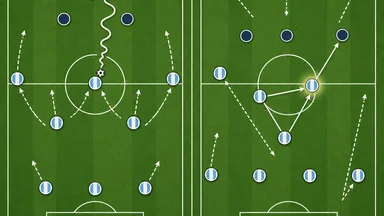
Brazil's coaching staff has experimented with several tweaks to address the playmaker gap. One option is a shift to a 4-2-3-1 with a dedicated No. 10—perhaps deploying Paquetá in that role while moving Rodrygo to the wing. Another is instructing Raphinha to invert more aggressively, creating central overloads similar to Neymar's 2014 role. Full-backs have been encouraged to underlap into half-spaces, adding an extra passing option in central areas.
In pre-tournament friendlies, these adjustments showed marginal gains. Against a mid-block opponent, Brazil's progressive passes increased by about 8% when a midfielder dropped into the backline to free a playmaker. However, the sample size is small, and the adjustments have not been tested against elite defensive teams. The team could also look to Germany's approach with Jamal Musiala, as analyzed in Jamal Musiala Bayern Dribbling Shapes Germany 2026 Creative Central Role.
Another potential solution is to rely more on the full-backs for creativity. Danilo and Alex Telles are capable of delivering crosses and underlaps, but neither has the playmaking vision of a midfielder. The team may need to accept that a full-fledged replacement for Neymar does not exist in the current squad and instead optimize the system around multiple creators.
Historical Precedent: 2006 Italy and 2010 Spain
World Cup history offers clear examples of teams that won with a defined creative hierarchy. Italy 2006 relied on Andrea Pirlo as a deep-lying playmaker, dictating tempo and launching attacks from deep. Spain 2010 used Xavi as a metronome, with Iniesta providing additional incision. Both teams had a clear "brain" on the pitch, and both lifted the trophy. Brazil 2026 lacks an equivalent figure—a player who can consistently pick the lock against a set defense.
France 2018 offers a partial counterpoint: their creative duties were shared between Antoine Griezmann (as a hybrid forward/creator) and Kylian Mbappé (as a dribbling threat). But Griezmann still averaged over two key passes per game and functioned as a de facto playmaker. Brazil 2026 does not have a player with that dual threat. The team's creative output is more diffuse, and no player exceeds 1.5 key passes per 90.
The lesson from these precedents is that while multiple creative outlets can work, they require a clear hierarchy or a player who combines dribbling and passing at an elite level. Brazil's current distribution lacks that hierarchy, leaving the team vulnerable in tight knockout matches.
The Verdict: Can Brazil Adapt Before Knockouts?
Group stage data confirms a playmaker gap in Brazil's 2026 build-up. The team's xG per shot, progressive pass rate, and through-ball frequency all trail 2014 levels. The coaching staff may trial a new setup against a weaker group opponent, such as deploying a more traditional No. 10 or instructing a midfielder to stay higher up the pitch. But reliance on individual brilliance—Vinícius dribbling past two defenders or Rodrygo curling a shot from distance—is not sustainable against elite defenses.
A potential round-of-16 match against a European powerhouse could expose the flaw. The quality of Brazil's full-backs, particularly Danilo and Alex Telles, might compensate partially by providing width and crossing options, but crossing alone rarely unlocks a compact defense. The team may need to accept that this version of Brazil is less creative than its 2014 predecessor and adjust expectations accordingly.
That said, the tournament is not over. Brazil has the talent to adapt, and the coaching staff has shown willingness to tweak the system. Whether those tweaks are enough to restore the depth of build-up play remains the central question of their 2026 campaign. For a broader look at how creative roles shape modern World Cup teams, see Florian Wirtz Leverkusen Progression Shapes Germany 2026 Creative Hub.
Alternative Approaches: What Other Teams Have Done
Several national teams have faced similar dilemmas and found solutions worth considering. The Netherlands in the 2010 World Cup relied on Wesley Sneijder as a central playmaker, but after his decline, the 2014 team distributed creativity among Arjen Robben, Robin van Persie, and Wesley Sneijder (still present but less dominant). That team reached the semifinals by blending individual brilliance with structured passing patterns. Their success suggests that a mix of dribblers and passers can compensate for the absence of a single creator, provided the tactical framework is clear.
Another example is Argentina's 2022 World Cup win. Lionel Messi functioned as the undisputed playmaker, but he was supported by Julian Alvarez's movement and Angel Di Maria's directness. The key was that Messi's role was flexible—he could drop deep, drift wide, or stay central as needed. Brazil 2026 lacks a player with that level of tactical freedom and passing range. Vinícius is effective in one-on-one situations but does not orchestrate the entire attack.
Conversely, Belgium's 2018 team had a similar issue: Eden Hazard and Kevin De Bruyne were both creators, but they sometimes overlapped in space, leading to inefficiency. Belgium's solution was to give De Bruyne deeper starting positions while Hazard operated higher. Brazil could adopt a similar division of labor, with Paquetá playing deeper to launch passes and Vinícius staying high to stretch defenses. However, this requires discipline that the current squad has not consistently shown.
Data-Driven Counter-Argument: Is the Playmaker Role Overrated?
Some analysts argue that the decline of the traditional playmaker is a natural evolution, not a weakness. In modern football, pressing and transition play often bypass the need for a fixed creator. Brazil's 2026 style, with its emphasis on quick vertical passes and dribbling, might be better suited to the high-tempo nature of contemporary tournaments. For instance, France won the 2018 World Cup without a classic No. 10; instead, they relied on Mbappé's pace and Griezmann's versatility. Similarly, Brazil could argue that their distributed creativity makes them harder to mark, as opponents cannot focus on shutting down one player.
Data from the 2026 group stage shows that Brazil's shot-creating actions (SCA) per 90 are actually higher than in 2014, though the quality of chances is lower. This suggests that while the team creates more opportunities, they are less dangerous. The trade-off between quantity and quality is a legitimate tactical choice. If Brazil can increase their shot volume against defensive teams, they might compensate for lower xG per shot through sheer numbers.
Moreover, Brazil's defensive solidity has improved compared to 2014. The 2026 team concedes fewer chances and has a better expected goals against (xGA) average. A more conservative approach that limits opponent transitions might be worth the sacrifice in creative depth. In knockout matches, a single goal can decide the game, and Brazil's ability to keep clean sheets could be more valuable than dominating possession.
However, this counter-argument has limits. Against elite defenses, shot volume alone does not guarantee goals. Brazil's set-piece reliance is a red flag, as dead-ball efficiency is harder to replicate consistently. The team's crossing data suggests they are forced into low-probability shots, which is a sign of tactical failure rather than a deliberate strategy. The coaching staff must weigh these factors carefully.
Conclusion: The Path Forward
Brazil's 2026 build-up play is a work in progress. The shift from a centralized playmaker to distributed creativity has reduced the team's ability to unlock compact defenses, but it has also made them less predictable and potentially more resilient. The key is to find a balance—either by elevating one player to a primary creator role or by refining the collective movement to generate higher-quality chances. Historical examples from 2006 Italy to 2010 Spain show that a clear creative hierarchy often leads to success, but modern examples like 2018 France prove that alternative models can work. Brazil's coaching staff has the talent and time to adjust, but the clock is ticking. The knockout stage will reveal whether their approach is sustainable or if they need to revert to a more traditional playmaker structure.