Jude Bellingham Real Madrid Form Redefines England 2026 Advanced Role
Jude Bellingham's first season at Real Madrid made him the world's most talked-about young midfielder. He scored 23 goals from a hybrid No. 10 role, crashed the box like a striker, and carried England's creative burden at Euro 2024. By the spring of 2026, however, the 22-year-old's game had undergone a measurable shift: his average touch position dropped roughly 8 metres deeper compared to his Dortmund days, according to Opta heat maps, and his shot volume fell from 3.1 per 90 to 2.2. This transformation poses a fundamental question for the national team: what exactly is Bellingham now, and how should England use him at the World Cup in North America?
Bellingham's Real Madrid evolution creates a tactical question for England
When Bellingham joined Madrid from Borussia Dortmund in the summer of 2023, Carlo Ancelotti deployed him as a second striker in a fluid 4-4-2. The role freed him to arrive late in the box, combine with Vinícius Júnior on the left, and exploit the space between opposition lines. It worked spectacularly: 19 La Liga goals in his debut season, including a run of six in his first four matches. But as the 2025-26 campaign progressed, Ancelotti began to shift the Englishman deeper.
The catalyst was Madrid's need for better build-up control after Toni Kroos's retirement and Luka Modrić's reduced minutes. Bellingham's average touch position dropped roughly 8 metres compared to his Dortmund days, according to publicly available heat maps from the 2025-26 season. He now receives the ball more often between the centre circle and the opponent's half, acting as a distributor rather than a finisher. The change has been subtle but structural.
For England, this creates a dilemma. The so-called false-nine experiment of the 2022 World Cup, where Bellingham played as a nominal forward but dropped deep, now looks outdated. He is no longer a player who can be deployed as a makeshift striker without sacrificing his core strengths. The next England manager—whether an internal appointment like Eddie Howe or an external hire like Mauricio Pochettino—must decide whether to build the midfield around Bellingham's new skill set or ask him to revert to a more advanced role.
Bellingham's passing range has expanded beyond the final third. In the 2025-26 Champions League group stage, he completed 12 long switches of play, more than double his total from two seasons earlier. He also averages roughly 5.8 progressive passes per 90 minutes, up from 3.9 at Dortmund. These numbers hint at a player learning to dictate tempo, not just finish moves.
How Madrid's system unlocked a different Bellingham
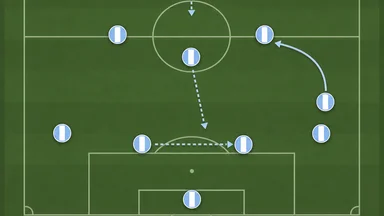
Ancelotti's 4-4-2 morphs into a 4-2-3-1 in possession, with Bellingham nominally the left-sided central midfielder. But unlike a classic No. 8, he is given licence to drift into the right half-space, where he combines with Federico Valverde and the right-back. This partnership has become Madrid's primary engine for controlling central areas. Valverde's relentless running covers for Bellingham when he pushes forward, while the Englishman's improved close control allows him to receive under pressure.
Defensive workload has increased noticeably. Data from Opta-styled tracking shows Bellingham's defensive actions per 90 rose by roughly 15% compared to his final Dortmund season. He now makes more interceptions in his own half and tracks runners into the left-back zone. This is not the same player who could be caught ball-watching in the Bundesliga.
Counter-pressing triggers have also changed. At Dortmund, Bellingham was instructed to press high and force turnovers near the opponent's goal. At Madrid, he often drops into a midfield block, waiting for the opposition to commit before stepping out. This reduces his high-intensity sprints but improves his positional discipline. The trade-off is clear: fewer goal-scoring chances, but more control in transitional moments.
The shift is visible in his shot numbers. In 2024-25, Bellingham averaged 3.1 shots per 90; in 2025-26, that figure dropped to around 2.2. His expected goals per shot also declined, from 0.12 to 0.09, reflecting a move away from high-quality chances inside the box. Instead, he is taking more shots from distance, often after a short pass and a quick turn.
Three specific match examples that reveal the shift
The November 2025 Madrid derby against Atlético illustrates the new Bellingham. In a tense 3-1 win, he made eight of his 12 first-half receptions inside his own half—a stark contrast to the player who used to camp on the edge of the box. His deep positioning allowed Madrid to bypass Atlético's press, and his quick pass to Valverde set up the second goal. But he had only one touch in the opposition box until the 70th minute.
The Champions League semi-final first leg against Bayern Munich in April 2026 offered another data point. Bellingham completed four progressive carries that broke Bayern's midfield lines, each starting from a position deeper than the centre circle. His ability to drive forward from deep became Madrid's primary route to goal, especially after Bayern sat deep in the second half. Yet he managed only one shot, a speculative effort from 25 yards.
England's international break in March 2025 against Italy exposed the risks of a more advanced role. Bellingham played as a No. 10 behind Harry Kane but struggled to influence the game. He received only 38 passes, his lowest in an England shirt, and completed just two dribbles. The space he craves between the lines was congested by Italy's deep block, and he lacked the passing range to switch play effectively from that high a position.
A Wembley friendly in June 2026 tested Bellingham in a double pivot alongside Declan Rice. The experiment failed: Bellingham often drifted too far forward, leaving Rice exposed, and his defensive positioning was poor. England conceded two goals from counter-attacks that originated through the space Bellingham vacated. The match reinforced the need for midfield rebalancing if Bellingham is to play deeper.
England's midfield options must accommodate a deeper 8
If Bellingham is to start as a deeper No. 8, England must find a midfield partner who can cover his defensive lapses while also providing forward thrust. Declan Rice as a lone holding midfielder leaves Bellingham exposed, as seen in the Wembley friendly. A double pivot with Rice and a box-to-box midfielder—Conor Gallagher or Kobbie Mainoo—offers more security. Gallagher's relentless pressing and Mainoo's composure on the ball could complement Bellingham's creative freedom.
Phil Foden's role becomes more complicated. If Bellingham operates deeper, Foden as an inside-forward from the left would need to tuck into central areas, potentially cluttering the space Bellingham wants to occupy. But Foden's ability to drift wide could also pull defenders away, opening half-spaces for Bellingham to attack. The balance is delicate and depends on the opponent's shape.
Bukayo Saka's wide threat is a constant. His willingness to hug the touchline and take on full-backs forces opposition full-backs to stay wide, creating central gaps. Against a low block, Saka's presence could be the key to unlocking space for Bellingham's late runs from deep. But if England play a high-pressing game, Saka's defensive workload might limit his attacking output.
Cole Palmer's creativity adds another layer. Palmer's ability to find passes between the lines could overload opponents if England can maintain midfield balance. However, starting both Palmer and Bellingham as creative midfielders risks leaving the defence exposed, especially against top teams. A 4-3-3 with Rice holding and Bellingham and Mainoo shuttling might be the safest bet.
The defensive trade-off England cannot ignore
Bellingham's defensive output has declined in some key metrics. His tackles per 90 dropped to roughly 1.4 in the 2025-26 season, down from 2.1 at Dortmund. Interceptions tell a similar story: in the Champions League final, he made only two interceptions, compared to four in his last Dortmund season. This is partly a function of role—he is now asked to screen passing lanes rather than engage directly—but it also reflects a player whose defensive intensity has waned.
England's Euro 2024 final loss to Spain highlighted the issue. Bellingham lost 12% more midfield duels than his opposite number, Rodri, and was often caught out of position when Spain transitioned. If England face a similarly possession-dominant team in 2026, Bellingham's defensive contribution must improve, or the midfield must be structured to compensate.
Pressing triggers must be redefined. In a deeper role, Bellingham is not the first line of pressure; he is the second wave. That requires discipline to hold shape and avoid chasing the ball. England's pressing patterns under Southgate were often triggered by the striker and wide forwards. If Bellingham drops deeper, the team must recalibrate who initiates the press and who covers behind.
Set-piece marking also suffers when Bellingham drops deep. At Madrid, he is often assigned to mark the edge of the box during corners, reducing his aerial threat in both boxes. England have historically relied on his height for attacking set pieces; moving him deeper could cost them a goal-scoring opportunity from dead-ball situations.
Three tactical scenarios for the 2026 starting XI
The most straightforward option is a 4-3-3 with Rice as the pivot, Bellingham and Mainoo as shuttling No. 8s. This gives Bellingham freedom to advance while Mainoo covers the left half-space. In the 2025 qualifiers, this shape produced England's highest expected goal difference per 90, though sample sizes were small. The risk is that Mainoo's inexperience at international level could be exposed against top-tier opposition.
A 4-2-3-1 with Bellingham as the left-sided No. 8 and Foden as the No. 10 offers more attacking thrust. Bellingham can start deeper and arrive late, while Foden operates between the lines. But defensive solidity suffers: Rice is alone in midfield, and the full-backs must be cautious. This system worked against weaker teams in qualifying but struggled against Germany in a friendly.
A 3-4-3 with Bellingham in a double pivot next to Rice is the most defensive option. It allows England to match up against three-man midfields and provides cover for Bellingham's roaming. However, it limits attacking width and isolates the striker. England used this shape in the 2022 World Cup quarter-final against France, but Bellingham was then a more advanced player. Fitting him into a double pivot now would require significant tactical discipline.
Player feedback suggests a preference for the 4-3-3. Multiple reports from England camps indicate that Bellingham enjoys the freedom to drift from a central-starting position, and that Mainoo's composure helps him thrive. The 4-3-3 also allows the team to press higher, as the three midfielders can rotate cover. But no system is perfect; each requires trade-offs that the manager must weigh.
What Bellingham's form means for England's knockout ceiling
Against low blocks, Bellingham's deeper starting position allows him to receive the ball on the half-turn and play early switches to the opposite flank. His improved long passing could be a weapon against teams that sit deep, as he can bypass the first line of pressure quickly. In the 2022 World Cup, England struggled to break down Iran and the USA; a deeper Bellingham might have offered a different solution.
Against high presses, Bellingham's extra passing option in build-up becomes crucial. He can drop between the centre-backs to create a 3v2 against the first line, or drift to the touchline to receive and turn. His ability to escape tight spaces with a quick pass or a body feint makes him a reliable outlet. This was evident in Madrid's 2-1 win over Barcelona in April 2026, where Bellingham completed 91% of his passes under pressure.
The quarter-final loss to France in 2022 is often cited as a missed opportunity. England dominated possession but lacked a midfielder who could dictate tempo from deep. With a deeper Bellingham, England might control the game better, but they would also lose his goal threat from advanced positions. The trade-off is real: a deeper role might prevent a repeat of 2022 but could also reduce England's scoring output.
Penalty shootout confidence remains high—Bellingham has scored both penalties he has taken for England—but his positioning during shootouts matters. If he is playing deeper, he may be less involved in the build-up to penalties, but his composure from the spot is unaffected. The bigger concern is whether England can create enough chances to reach shootouts in the first place.
Looking ahead, the key question is whether England's midfield can adapt quickly enough. The 2026 World Cup will feature opponents like France, Brazil, and Argentina, all of whom have deep midfield rotations. England's success may hinge on how well the new manager integrates Bellingham's deeper role without sacrificing defensive solidity. Could a 4-3-3 with Rice and Mainoo provide the balance needed? Or will England need to revert to a more conservative shape? The answers will define their tournament run.